
Descrizione
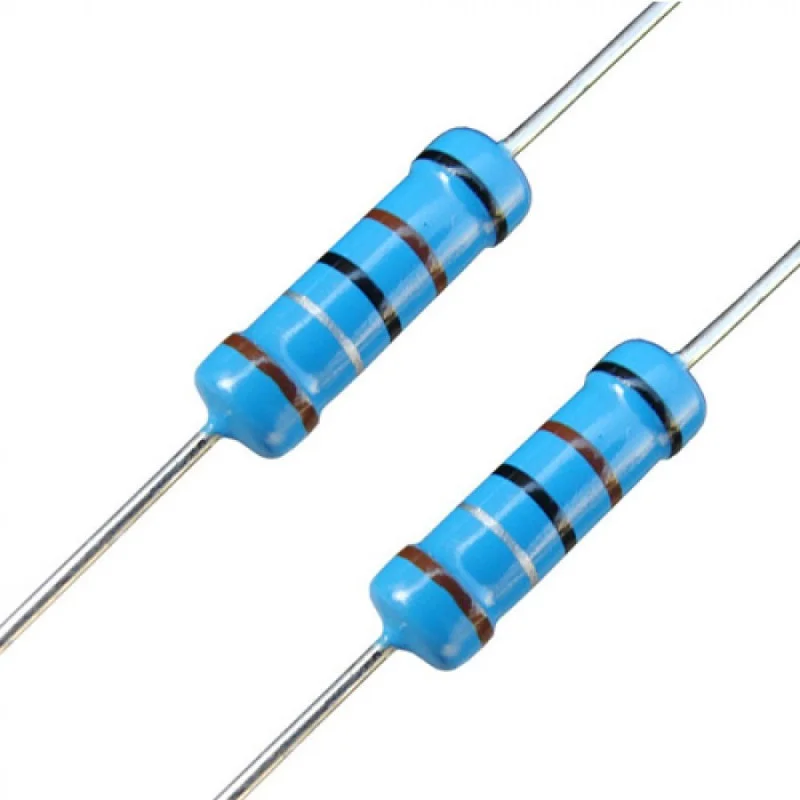
A metallized resistor is a passive electronic component designed to limit current, divide voltage, and adjust operating conditions in electronic circuits. This product is in axial through-hole design and is suitable for general use in analog and digital applications, repair, prototyping, and PCB assembly.
Technical specifications
Component type: metallized resistor
Rated power: 0.25W
Tolerance: 1%
Temperature coefficient: ±50 ppm/°C
Design: axial
Body length l: 6.5 mm
Body diameter d: 2.5 mm
Length of terminals a: 28 mm
Terminal diameter da: 0.6 mm
Maximum voltage: 250 V
| ±0.5mm | d ±0.3mm | and ±3mm | da±0.05mm | max. voltage | |
| 0.25W (1/4W) | 6.5mm | 2.5mm | 28mm | 0.6mm | 250V |
Functions and features
Designed for a fixed value of electrical resistance in a circuit.
The metallized design supports more precise resistance tolerance.
The axial design is suitable for through-hole mounting in printed circuit boards as well as for point wiring.
Suitable for installation in low-power electronic devices and assemblies.
Ideal for
Electronics repairs and service
Construction and prototyping of electronic circuits
PCB assembly
Measuring, control and signal circuits
Package contents
1 pc of metallized resistor in axial design
Why choose this product?
The basic electrical and mechanical parameters are clearly stated.
A tolerance of 1% is suitable for applications where a more accurate resistance value is required.
The axial design facilitates installation in common through-hole connections.
The dimensions and diameter of the terminals are suitable for standard electronic assembly.
Installation and operating instructions
When installing, do not exceed the rated power and maximum operating voltage of the component.
Install the resistor in such a way that there is no mechanical stress on the body or terminals.
When soldering, limit the time of thermal stress to the necessary minimum.
For proper operation, select the appropriate resistor value according to the circuit design.
Safety notice
When overloaded, the component can overheat and damage surrounding elements.
Incorrect connection or exceeding the limit values may cause component failure or a short circuit in the device.
When using in higher voltage circuits, follow the rules for safe work on electrical equipment.
Installation and use in mains or otherwise hazardous circuits requires appropriate expertise.
Recensioni
Ancora non ci sono recensioni.